
Key takeaways
- According to the OECD, average Multifactor Productivity growth across 21 countries declined to around -0.3 percent in 2023-2024, making the cost of institutional inertia concrete and measurable.
- According to the OECD, 29 countries saw labor productivity gains in 2024, suggesting that AI adoption in digital-intensive industries is already producing results that offset broader economic headwinds.
- The dominant barrier to AI value is not access to tools or capital, it is the psychological stance a leader chooses to take toward an unfamiliar technology.
- Fear-based hesitation is not a neutral position; it is a decision with compounding consequences as competitors and colleagues move forward.
- Curiosity, treated as a professional discipline rather than a personality trait, is the practical mechanism through which organizations convert AI access into AI results.
The productivity data changes the stakes
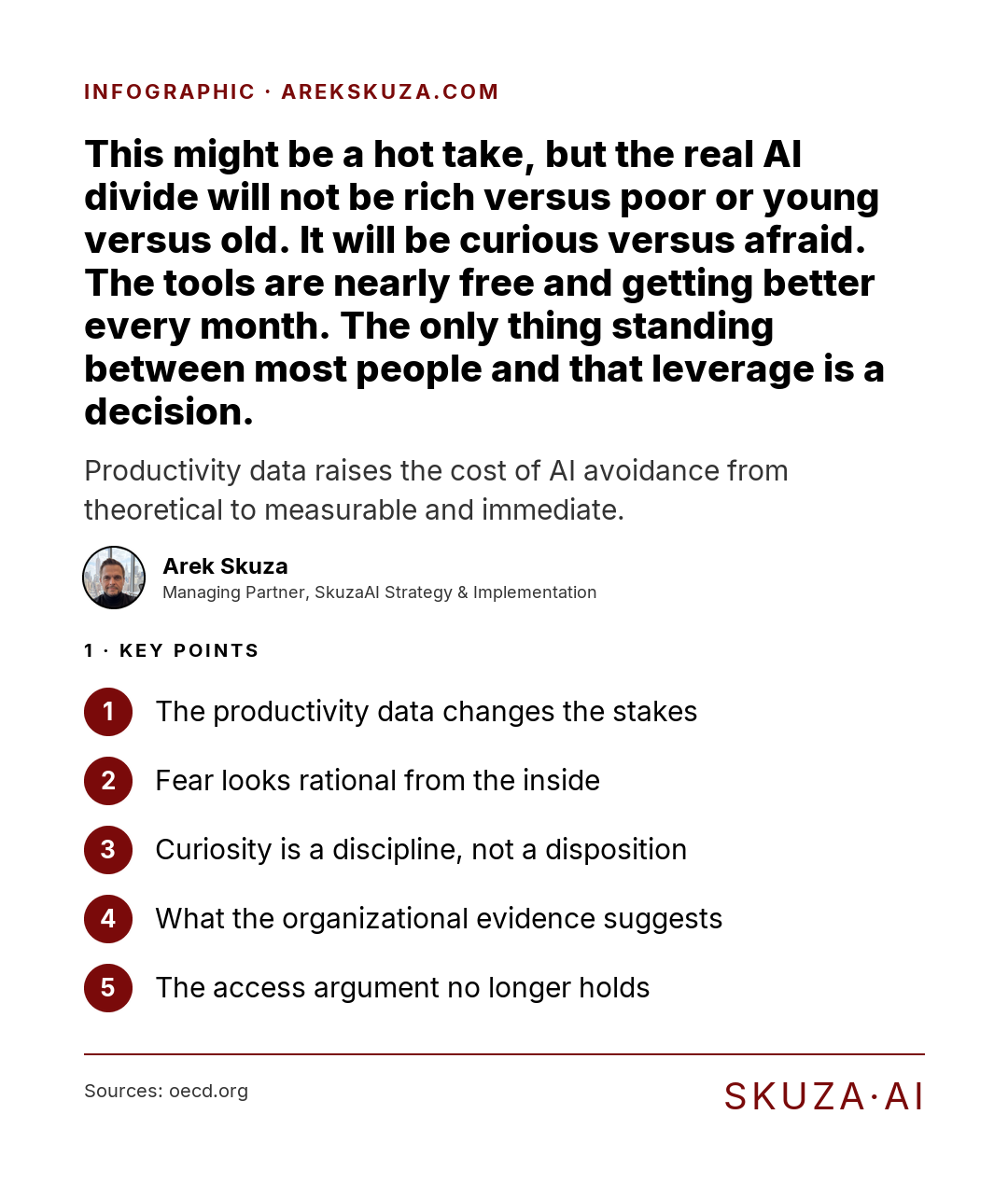
Productivity data raises the cost of AI avoidance from theoretical to measurable and immediate. According to the OECD’s Compendium of Productivity Indicators, average Multifactor Productivity growth across 21 countries fell to around -0.3 percent in 2023-2024, extending a decline that has run since the early 2000s (OECD, 2026). Productivity at the economy-wide level is going backward. That is the baseline against which every AI decision a CEO makes now sits.
Yet the same OECD data shows a split. In 2024, 29 OECD countries recorded labor productivity gains, and the pattern points toward digital-intensive industries where AI adoption was more deliberate (OECD, 2026). The divide is not between sectors that had more money or better engineers. It is between organizations that chose to engage with new tools and those that waited for certainty before committing.
Waiting for certainty in a technology that is improving every month is itself a strategic bet. It just happens to be a losing one.
Fear looks rational from the inside
Fear of AI rarely presents itself as fear, arriving instead dressed as prudence or governance language. It shows up as “We need to understand the risks first” or “We’re building a framework before we deploy anything.” These are not wrong instincts in isolation, but they become traps when they function as indefinite holding patterns rather than time-boxed assessments.
The fear is real and worth naming honestly. Leaders worry about accuracy, about liability, about what AI-generated outputs will do to their brand if they are wrong in public. They worry about jobs, about culture, about moving too fast on something they do not yet fully understand. Those concerns have legitimate foundations.
What they do not have is a cost-free default. Every week spent in review mode is a week in which others are running experiments, learning from failures, and widening the capability gap. The fearful stance feels like standing still. It is not.
Curiosity is a discipline, not a disposition
Curiosity toward AI is a daily professional decision, not a personality trait a leader either has or lacks. Curious leaders are people who have decided that understanding something is more useful than fearing it, and who treat that decision as a daily practice. In this context, curiosity means running a small test before writing a policy, and asking what the tool actually does before deciding what it cannot be trusted to do.
This distinction matters for CEOs specifically. You do not need to become a prompt engineer. You need to have enough direct experience with AI tools to form your own judgment rather than inheriting the judgment of whoever briefed you last. That requires use, not just reading about use.
The tools available at no cost today would have been considered research-grade capabilities several years ago. The barrier is not financial. It is attitudinal.
What the organizational evidence suggests
Organizations that generate measurable value from AI share a pattern: leaders at the top are personally engaged with the technology, not just its governance. They have tested it, been wrong about it, and adjusted. That cycle of personal experimentation creates the conditions under which teams feel licensed to experiment too.
The reverse is also true. When a CEO’s primary relationship with AI is mediated through a risk committee and a policy document, the signal that sends down the organization is unmistakable. People learn to manage upward rather than move forward, waiting for permission that never quite arrives in usable form.
The OECD productivity data captures exactly this dynamic at scale. The countries and sectors showing gains in 2024 are the ones where experimentation became normal, not exceptional (OECD, 2026), and the macro trend and the organizational behavior are the same phenomenon at different levels of zoom.
The access argument no longer holds
Capable AI tools are now available at free or very low-cost tiers, making access a weak excuse for hesitation. A CEO of a ten-person firm and a CEO of a ten-thousand-person firm face nearly identical access conditions when it comes to foundational AI capabilities, because the compute burden sits with the platforms, not the user. The framing that positions AI adoption as a resource question is increasingly outdated.
This makes the choice more uncomfortable, not less. When access was genuinely scarce, hesitation had a structural excuse. When access is cheap and widely available, hesitation is a statement about appetite for uncertainty, about tolerance for being a beginner, and about willingness to form views through action rather than analysis.
That is not a resource question. That is a character question.
The compounding cost of the fearful position
Fear compounds directionally, turning a small early gap into an accelerating structural disadvantage. An organization that avoids AI in year one falls behind slightly, but in year two the gap is larger because competitors have moved up the learning curve. By year three, the gap includes not just capability but culture: the curious organization has built habits, norms, and institutional knowledge that cannot be replicated quickly.
The OECD data points to this compounding effect. The productivity divergence between digital-intensive adopters and the broader economy is not a one-time step change but a trajectory, and organizations on the wrong side of that trajectory face an accelerating catch-up problem, not a stable one (OECD, 2026). This is why the framing of “curious versus afraid” is more precise than “early adopter versus late adopter.” Timing is a symptom; the underlying cause is the emotional and cognitive stance a leader has chosen toward uncertainty itself.
What this means for the decision in front of you
The real decision is whether you will engage with AI directly enough to lead your strategy with conviction. Most CEOs already have an AI strategy in some form, but managing it from a distance and hoping the gap does not widen faster than your governance process can close it is a different posture than leading it. That difference is what the productivity data is measuring.
Curiosity at the executive level is not about being enthusiastic. It is about being willing to be wrong in a low-stakes setting so that you are less wrong in a high-stakes one. Treating the next hour with an AI tool as the research it actually is, rather than as something to delegate entirely, is where that posture begins.
The tools are here. The productivity data shows what engagement produces. The only remaining variable is the stance you choose to take.
FAQ
Is fear of AI a reasonable position for a CEO to hold?
Fear is a reasonable starting point, but not a sustainable operating position. The OECD’s productivity data shows that economies and sectors engaging with AI are already separating from those that are not, which means extended caution has a measurable cost that grows over time.
Do smaller organizations need AI in the same way larger ones do?
Access to foundational AI tools is now broadly similar across organization sizes, since the compute cost sits with platform providers rather than users. This means the productivity gap that AI creates between curious and reluctant organizations is as relevant for a small firm as a large one.
How should a CEO start building personal familiarity with AI?
Direct use of available tools in a low-stakes context is the most practical starting point. The goal is to form a first-hand view of what AI actually does well and where it fails, rather than relying entirely on briefings or policy documents that describe the technology at one remove.
What is the difference between managing AI risk and avoiding AI entirely?
Managing risk involves time-boxed assessment, defined test cases, and clear criteria for proceeding. Avoidance involves indefinite deferral dressed in the language of governance. The first produces learning; the second produces a widening gap with no clear end point.
Can the productivity gains visible in the OECD data be attributed specifically to AI?
The OECD data shows that 29 countries recorded labor productivity gains in 2024, with the pattern concentrated in digital-intensive industries (OECD, 2026). Attribution to AI specifically is difficult to isolate, but the concentration in sectors where AI adoption is highest is consistent with a directional relationship.