
Key takeaways
- According to Gartner, a majority of agentic AI projects are predicted to be canceled in the near term, most of them not because the models are unintelligent but because agents cannot access the right context at the right time.
- According to superkind.ai, 90% of enterprise data is unstructured, meaning the critical knowledge that agents need lives inside documents, contracts, research files, and financial plans rather than in queryable databases.
- According to atlan.com, institutional knowledge loss is a direct risk when enterprises fail to structure and share context, leaving both agents and new employees unable to act on accumulated organizational wisdom.
- According to wakefieldresearch.com, data silos have become an existential threat as AI agent deployments scale, because an agent that cannot reach relevant content cannot complete its task reliably.
- According to businessplusai.com, the most common AI agent failures trace back to structural problems in how information is organized and surfaced, not to the underlying model’s reasoning capability.
The real bottleneck is not the model
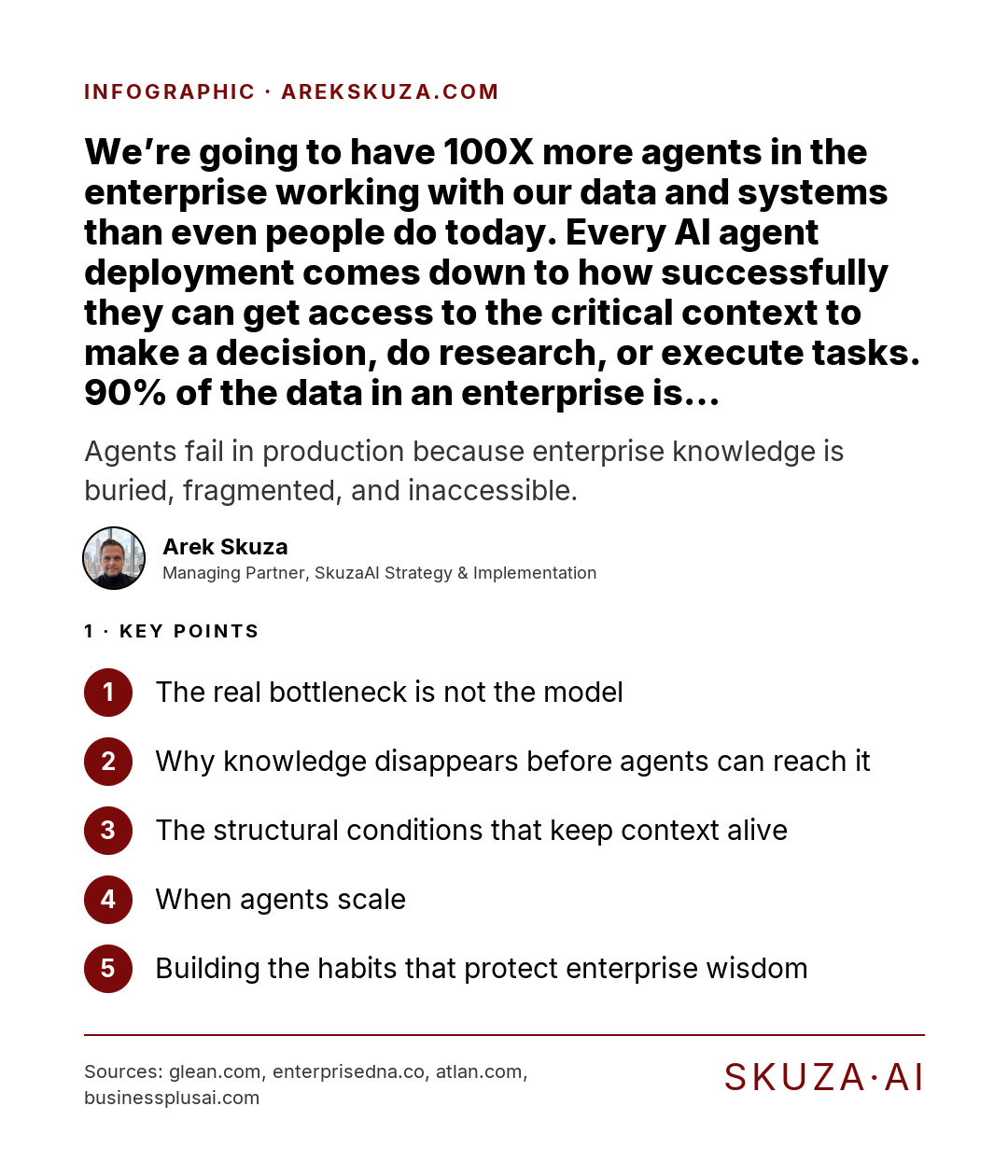
Agents fail in production because enterprise knowledge is buried, fragmented, and inaccessible. The language model sitting behind your agent deployment may reason well. But reasoning requires raw material, and in most enterprises that raw material is locked inside PDFs, slide decks, email threads, contract folders, and shared drives that were never designed to be machine-readable at scale.
According to superkind.ai, 90% of enterprise data is unstructured. That figure deserves a moment. It means the overwhelming majority of what your organization knows, the decisions it has made, the deals it has won, the mistakes it has learned from, exists in a form that standard databases cannot query. When an agent needs context to execute a task, it is hunting through that majority.
The scale of the coming deployment wave makes this urgent. Enterprises are moving toward a future where agents outnumber employees by an order of magnitude, working across procurement, legal review, customer support, research synthesis, and financial planning simultaneously. Each of those agents needs context to act. Without it, they produce confident-sounding output grounded in nothing specific to your organization.
Why knowledge disappears before agents can reach it
Organizational knowledge erodes the moment it is not actively captured, and most organizations have no capture discipline. A senior deal-maker closes a complex contract. The judgment calls, the stakeholder dynamics, the last-minute concessions, all of that sits in their head or in a chain of emails that no one will tag, index, or surface to a future agent workflow.
According to atlan.com, institutional knowledge loss is a direct and measurable risk when enterprises fail to build systems that preserve and share context. The problem compounds with every departure, every reorganization, and every system migration that leaves content stranded in a legacy tool. What looks like a data management issue is actually a strategic liability.
The agent deployment problem sharpens this further. A human employee can ask a colleague. An agent cannot. It can only retrieve what has been made retrievable. If your enterprise has not solved the question of how knowledge gets captured and surfaced, every agent you deploy will be operating with a systematically incomplete picture of your business.
According to businessplusai.com, the most common reasons AI agent deployments fail are structural rather than technical, pointing directly at how information is organized and accessed rather than at the model’s reasoning ability. The fix is therefore upstream of the AI itself.
The structural conditions that keep context alive
Enterprises keep context alive by treating knowledge as a living asset, not a byproduct of daily work. That means content must be created with retrieval in mind, organized in ways that preserve meaning across time, and made accessible to agents through pathways that respect both structure and provenance.
According to glean.com, an enterprise knowledge graph that connects people, content, and activity creates the retrieval foundation that agents require. The graph does not just store documents; it records relationships, recency, authorship, and use patterns. An agent querying a knowledge graph can find not just the document but the context around it: who wrote it, when, in response to what, and how it has been used since.
According to wakefieldresearch.com, data silos are an existential threat to AI agent performance at scale. Breaking those silos is not primarily a technology project. It is a governance decision. It requires leadership to mandate that content produced in one system is discoverable from others, and that the metadata which makes retrieval meaningful, such as ownership, date, project context, and decision status, is attached at creation rather than retrofitted later.
The organizations that will get compounding value from agent deployments are those that treat the content layer as infrastructure. They set standards for how documents are titled, tagged, and stored. They build workflows that push completed work into indexed repositories automatically. They retire the habit of treating a finished deliverable as a personal asset sitting in someone’s drive.
When agents scale, so does the cost of missing context
Scaling agent deployments multiplies the cost of every gap in organizational context. According to Gartner, a large share of agentic AI projects is predicted to be canceled in the near term. The failures are rarely about the AI being wrong in principle. They are about the AI being wrong in this instance because it lacked the specific, current, organizational context to be right. That is a knowledge architecture failure, not a model failure.
According to enterprisedna.co, AI agent adoption across the enterprise is accelerating rapidly, which means the exposure to context failures scales proportionally. One agent running with incomplete context is an isolated mistake. A hundred agents running with systematically incomplete context is an operational risk that compounds every hour they operate.
The measurement problem makes this worse. According to businessplusai.com, most organizations still apply outdated metrics to AI deployments, looking for immediate headcount reduction rather than tracking whether agents are actually operating on accurate, complete, and current organizational knowledge. By the time the bad outputs surface, significant decisions may already have been made on them.
There is also a competitive dimension. According to dippai.com, organizations that build durable, well-structured knowledge assets create a compounding moat. Each well-captured decision, each indexed piece of research, each tagged contract makes the next agent query slightly more accurate. Over time, the enterprise with better knowledge architecture produces systematically better agent outputs than a competitor with a richer model but poorer content infrastructure.
Building the habits that protect enterprise wisdom
Protecting enterprise wisdom requires treating knowledge capture as a production input, not an administrative afterthought. This starts with accountability at the point of creation. The person who closes a deal, completes a research review, or finishes a financial model should leave that work in a state where an agent can find it and understand it. That means consistent naming, meaningful metadata, and storage in an indexed system rather than a personal folder.
It also means recognizing that context decays. A contract from several years ago may describe a relationship that has since changed completely. Agents retrieving that document without knowing its age or status will misrepresent the current reality. Version control, review cycles, and clear deprecation signals are therefore part of the knowledge architecture, not optional extras.
According to IDC, enterprises that invest in proper data foundations for AI see meaningfully better outcomes from their AI deployments. The investment is not in the model. It is in the layer below the model: the content, the metadata, the retrieval pathways, and the governance that keeps all of it current and trustworthy.
Leadership has a specific role here that cannot be delegated to an IT team. The question of what knowledge gets captured, how it gets organized, and who is responsible for maintaining it is a strategic question. It determines what your agents will be capable of. It determines whether the institutional wisdom your organization has accumulated over years becomes a durable asset or a liability that erodes with every staff change and system migration.
FAQ
Why do AI agents fail even when the underlying model is highly capable?
Agents fail because they lack access to the specific organizational context needed to make a good decision in a given situation. According to businessplusai.com, the most common failures are structural, rooted in how information is organized and surfaced rather than in any weakness in the model’s reasoning.
What makes unstructured data such a significant problem for agent deployments?
Unstructured data is the default format for most enterprise knowledge, and agents cannot query it without deliberate retrieval infrastructure. According to superkind.ai, 90% of enterprise data is unstructured, which means the majority of what an organization knows sits in documents, contracts, and files that require indexing and metadata before an agent can use them reliably.
How does institutional knowledge loss connect to AI agent performance?
When experienced employees leave without capturing their judgment, context, and decisions in retrievable form, agents operating in their former domains are left without that accumulated wisdom. According to atlan.com, institutional knowledge loss is a direct risk factor for organizations that have not built systems to preserve and share context.
What is the leadership decision that matters most for fixing this?
The most important decision is to treat knowledge capture as a production standard rather than an optional practice. That means mandating consistent metadata, indexed storage, and retrieval-ready formatting at the point of content creation, enforced as a standard across the organization.
Will better AI models eventually solve the context problem without structural changes?
A more capable model still requires accurate, current, organization-specific context to produce accurate, organization-specific outputs. The model can reason better over good content, but it cannot manufacture context that was never captured. The structural work of building a retrievable knowledge layer is a prerequisite, not an alternative, to deploying more capable agents.