
Key takeaways
- For 95% of companies in the dataset, generative AI implementation is falling short, according to MIT NANDA’s The GenAI Divide: State of AI in Business 2025, via Fortune.
- Gartner forecasts $2.7tn in worldwide AI spending in 2026, a +49.5% year-on-year increase, meaning the gap between spend and return is widening, not narrowing.
- Gartner predicts over 40% of agentic AI projects will be cancelled by end of 2027, and the evidence points to process readiness as a primary cause.
- Genpact data shows that only 46% of processes across a large sample of organizations are formally documented and governed by standard operating procedures, leaving the other half invisible to any AI agent.
- McKinsey’s State of AI 2026 survey finds that 37% of companies report positive EBIT contribution from AI, and just 6% qualify as high performers, confirming that financial return remains the exception.
The wrong first question costs real money
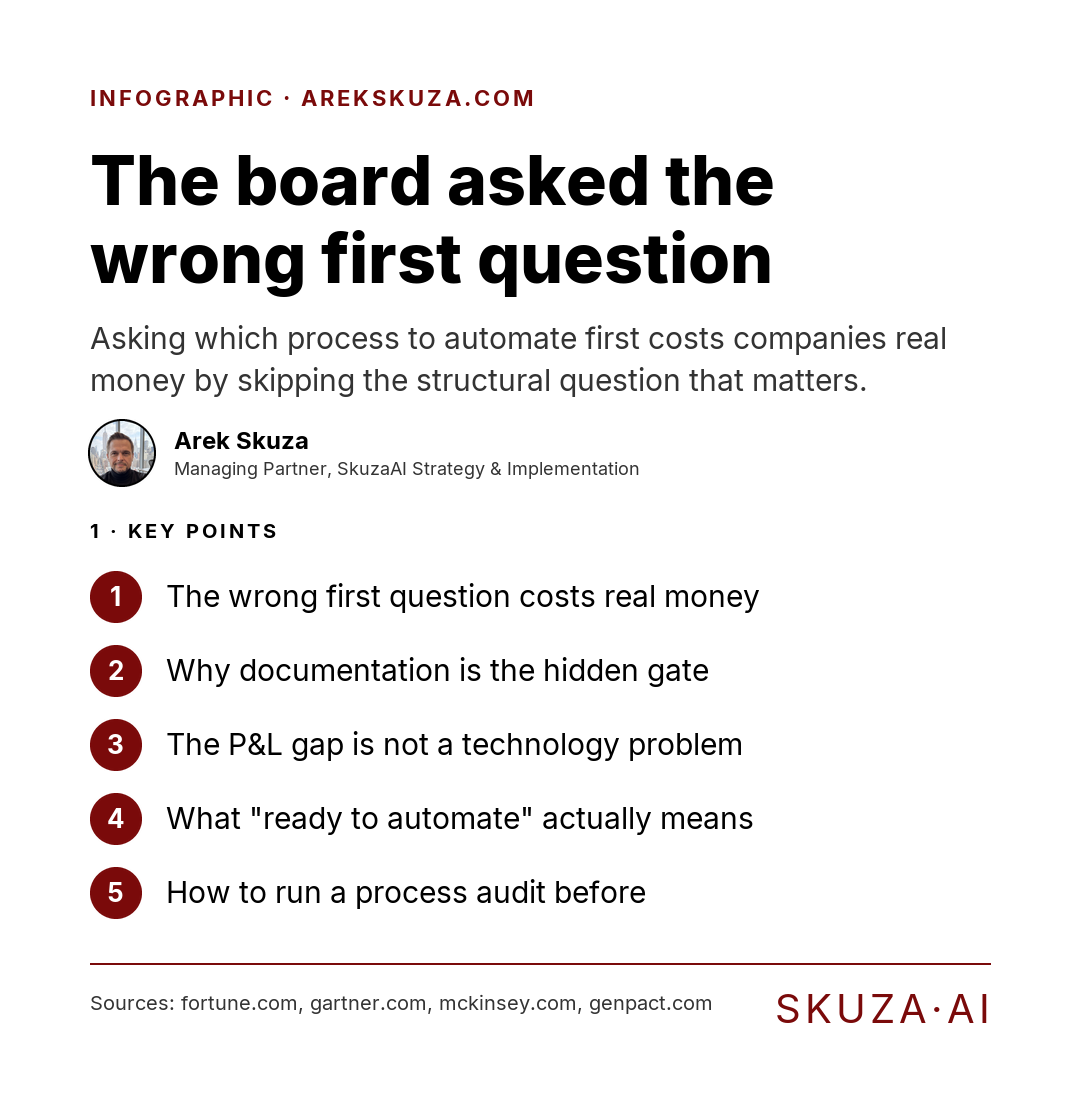
Asking which process to automate first costs companies real money by skipping the structural question that matters.
The more productive question is structural: is any given process documented clearly enough for an AI agent to follow without human interpretation at every step? That question exposes the actual constraint. A process that lives only in the memory of three experienced employees is not an automation candidate. It is a documentation project wearing an automation budget.
Gartner forecasts $2.7tn in worldwide AI spending in 2026, up 49.5% year on year. That scale of investment demands a sharper pre-flight check than enthusiasm and a shortlist of candidates.
Why documentation is the hidden gate
Documentation is the hidden gate because an AI agent cannot infer intent from ambiguity the way a skilled employee can.
It needs explicit rules, defined inputs, known exception paths, and stated success criteria. Without those, the agent either halts or, worse, produces output that looks correct and is not.
Research published on J-Stage found that 46% of process patterns in the studied workflow system were undocumented. Genpact’s enterprise debts report, drawing on 2,002 respondents, found that only 46% of processes are formally documented and governed by SOPs. Those two figures, from different research contexts, converge on the same uncomfortable fact: roughly half of what an organization does is not written down in a form that a system can act on.
The same Genpact research identifies data debt as an even more prevalent problem than process debt, 33% versus 23% of respondents citing it as their primary barrier. Documentation is a first gate, not the only one. Getting through it does not guarantee success. Failing to clear it guarantees failure.
The P&L gap is not a technology problem
MIT NANDA’s The GenAI Divide: State of AI in Business 2025, reported via Fortune on 18 Aug 2025, found that for 95% of companies in the dataset, generative AI implementation is falling short. That figure has drawn methodological scrutiny from Futuriom and from Wharton’s Kevin Werbach, who argue the sample is undisclosed and the 5% “successful” category is defined more narrowly than the headline implies. Even discounting for that criticism, the directional signal is consistent with McKinsey’s State of AI 2026, which puts the share of companies reporting positive EBIT contribution at 37%, with high performers at just 6%.
The gap between AI spend and AI return has a structural cause. Boards approve budgets for tools and vendors. They rarely approve a prior phase of work: mapping what their processes actually do, checking where the documentation ends, and deciding which gaps to close before any agent touches live data. That phase is unglamorous, it does not appear on a demo slide, and skipping it is exactly why the spend fails to reach the profit and loss statement.
What “ready to automate” actually means
A process is ready for an AI agent when four conditions hold: the steps are written down in enough detail that a new hire could follow them without asking questions, the exceptions are catalogued rather than just the happy path, the inputs and outputs are defined in machine-readable terms, and the success criteria are measurable rather than qualitative.
Gartner predicts over 40% of agentic AI projects will be cancelled by end of 2027, linking this to unrealistic expectations and inadequate process governance. That prediction is consistent with the documentation picture: organizations are deploying agents into processes that were never specified at the precision those agents require. Cancellation is not a failure of the technology but the predictable result of treating documentation as optional.
WPP’s Elevate28 plan targets £500m in savings and sets agentic workflow scaling for 2028 and beyond. That sequencing is deliberate: the savings come first, partly from earlier cost actions, and the agentic layer is timed to land after the operational foundation is in better order. Whether WPP achieves the target is a separate question. The sequencing logic is sound.
How to run a process audit before the next board approval
A process audit run before board approval requires asking three questions about every process on the automation shortlist.
Those questions are: who currently owns the written specification, when it was last reviewed, and what happens when it goes wrong. Processes that cannot answer all three in a single meeting are not automation candidates but documentation priorities. Routing them to an AI budget before the documentation exists adds cost without adding capability.
The board’s job is to hold that line before the vendor conversation starts, not after the pilot fails. Cherryleaf’s analysis of AI agents and SOPs makes the point plainly: agents require the same level of procedural clarity that a standard operating procedure is designed to provide. That is not a novel technical requirement; it is what a well-run operations function has always needed. The difference is that a human employee can ask a clarifying question mid-task, while an agent generally cannot, or will not do so at the right moment.
FAQ
Why does AI spending keep growing if returns are so low?
Spending and return operate on different timelines, and the organizations committing capital now are betting on future advantage, not current payback. Gartner forecasts $2.7tn in worldwide AI spending in 2026, a 49.5% increase, driven by competitive pressure as much as demonstrated return. The risk is that the investment outpaces the operational readiness needed to generate a return.
Is process documentation really the main reason AI projects fail?
Documentation is a primary gate, but not the only one. Genpact’s research identifies data debt as an equally significant barrier, with 33% of respondents citing it versus 23% for process gaps. A project can clear the documentation hurdle and still fail on data quality, change management, or integration complexity.
What should a CEO do differently at the next board AI review?
Before approving any automation budget, require a documentation audit of the target processes. Ask each process owner to produce a written specification, an exceptions catalogue, and measurable success criteria. Any process that cannot clear those requirements in a defined period is funded for documentation work first, not for tooling.
How does the 95% figure from MIT NANDA square with McKinsey’s more moderate numbers?
The two studies measure different things. MIT NANDA’s figure, reported via Fortune, reflects whether implementation is “falling short” on a broad set of business outcomes. McKinsey’s 37% measures positive EBIT contribution specifically. Futuriom and Wharton’s Kevin Werbach have noted that the MIT NANDA sample methodology is undisclosed, so the number should be treated as directional. Both datasets point to the same conclusion: financial return from AI is rare, not common.
Does this mean boards should slow down AI investment?
Not necessarily slow down, but resequence. The investment in process documentation is not a delay; it is a prerequisite. Organizations that complete it before deploying agents are more likely to appear in the 6% high-performer cohort that McKinsey identifies than those that treat documentation as a task to handle after the pilot is already live.
Sources
- The GenAI Divide: State of AI in Business 2025, via Fortune
- Gartner Forecasts Worldwide AI Spending to Grow 49.5% in 2026
- Gartner Predicts Over 40% of Agentic AI Projects Will Be Canceled by End of 2027
- The State of AI: Global Survey 2026, McKinsey
- $18 trillion, Genpact Enterprise Debts Report
- What Proportion of Industrial Business Processes Are Undocumented, J-Stage