

What’s at Stake
As we enter 2026, a stark reality has emerged in the enterprise AI landscape: a widening chasm between transformative success and modest returns. Only a select few companies—approximately 6% according to recent research—are realizing extraordinary value from AI investments, capturing surging top-line growth and commanding significant valuation premiums. The majority of organizations are experiencing measurable but modest ROI—efficiency gains here, capacity growth there, and general productivity boosts that, while positive, fall short of true transformation.
This value divide isn’t merely about technology adoption; it represents a fundamental strategic inflection point. Companies that cross the threshold to transformative AI implementation are reshaping competitive landscapes, redefining customer experiences, and creating entirely new business models. Those that don’t risk being left behind in an accelerating winner-takes-most market dynamic where AI capabilities increasingly determine market leadership.
The picture is shifting, however. Success patterns are becoming visible and replicable. From mature systems to emerging tools like AI agents, examples of transformative impact are multiplying across strategy, operations, workforce management, and sustainability initiatives. The question for C-suite leaders is no longer whether AI can drive transformation, but rather why transformative success remains concentrated among so few, and how to join their ranks.
What the Numbers Say
78% of organizations now report using AI in some capacity, a dramatic increase from 55% just one year ago, yet only 6% achieve enterprise-wide EBIT impact of 5% or more.
95% of generative AI pilots fail, not due to model quality but because of flawed enterprise integration and organizational learning gaps.
40% average profitability increase experienced by companies that effectively integrate AI into their core business processes, compared to industry peers.
From Sporadic Bets to Strategic Transformation
Too often, organizations spread their AI efforts thin, placing small sporadic bets across the enterprise without a cohesive strategy. The deceptive ease of implementing point solutions creates an illusion of progress, with early wins masking deeper organizational challenges. This approach yields incremental improvements but fails to deliver the step-change in performance that characterizes true AI leaders.
The fundamental challenge is one of strategic focus and execution discipline. Transformative results require precision in selecting a few high-impact areas where AI can deliver wholesale change in ways that materially affect business outcomes. This must be followed by steady, methodical execution that starts with senior leadership commitment and cascades throughout the organization.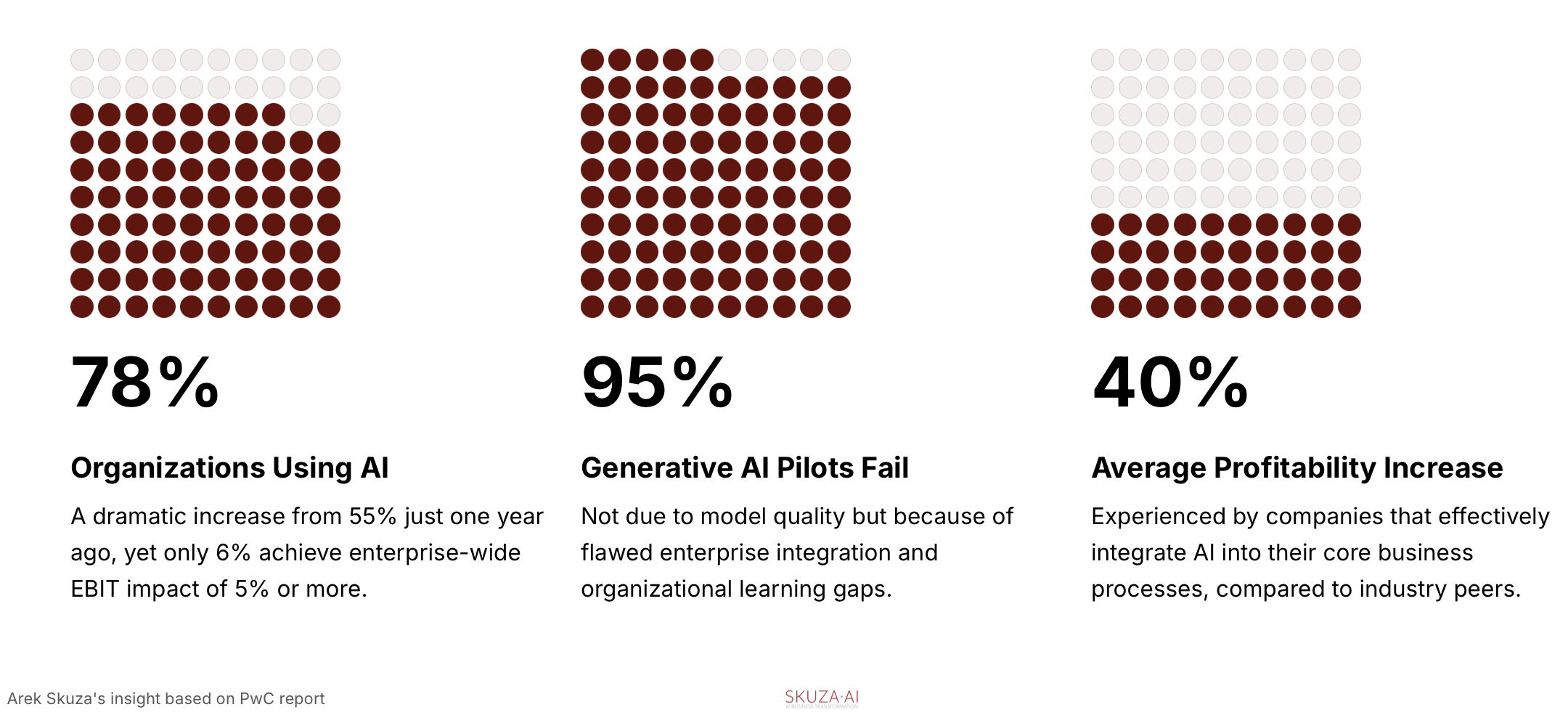
Companies that successfully cross the AI value divide share common characteristics: they view AI not as a technology initiative but as a business transformation enabler; they redesign workflows rather than simply automating existing processes; and they build the organizational capabilities needed to scale beyond initial successes.
Potential First Step
Begin with a comprehensive assessment of your current AI initiatives against business impact potential. Identify areas where AI could fundamentally transform your business model or customer experience, rather than simply improving efficiency. Consolidate resources behind these high-potential opportunities, even if it means deprioritizing other initiatives that deliver only incremental gains.
Architecting the AI-Enabled Enterprise
The most successful AI implementations are built on a foundation of enterprise-wide capabilities that extend beyond technology. While infrastructure and data are essential components, equally important are the operating model, talent strategy, and governance frameworks that enable AI to scale.
High-performing organizations approach AI architecture holistically, addressing five critical dimensions:
1. Data Foundation: They establish enterprise-wide data governance, quality standards, and integration capabilities that make data accessible and usable across the organization.
2. Technology Infrastructure: They build flexible, scalable platforms that support both current AI applications and future innovations, with particular attention to the rapidly evolving agent-based AI landscape.
3. Operating Model: They redesign workflows and decision processes to leverage AI capabilities, rather than simply layering AI onto existing ways of working.
4. Talent Strategy: They develop a multi-tiered approach to building AI capabilities, combining targeted hiring, strategic partnerships, and comprehensive upskilling programs.
5. Governance Framework: They implement robust governance mechanisms that balance innovation with risk management, addressing ethical considerations, regulatory compliance, and performance monitoring.
Potential First Step
Conduct an honest assessment of your organization’s maturity across these five dimensions. Identify the most significant gaps and develop a prioritized roadmap to address them. For most organizations, data foundation and operating model changes represent the most challenging but impactful areas for improvement.
Elevating AI from Function to Strategy
A defining characteristic of AI leaders is their ability to elevate AI from a functional capability to a strategic asset. While 80% of companies set efficiency as their primary AI objective, high performers additionally prioritize growth and innovation. This strategic orientation manifests in several ways:
First, AI leaders integrate AI considerations into their strategic planning processes, evaluating how emerging capabilities might reshape industry dynamics, customer expectations, and competitive positioning. They ask not just how AI can improve what they do today, but how it might enable entirely new business models tomorrow.
Second, they establish clear linkages between AI initiatives and strategic priorities, ensuring that investments are aligned with the organization’s most important objectives. This alignment extends to performance metrics, with AI success measured not just in technical terms but in business outcomes.
Third, they create governance structures that elevate AI decisions to the appropriate level. While implementation remains distributed, strategic direction and resource allocation are guided by senior leadership with a enterprise-wide perspective.
Potential First Step
Establish a cross-functional AI strategy council, led by a senior executive with both business and technology credibility. Task this council with identifying strategic opportunities where AI could create significant competitive advantage, and with ensuring that AI investments are aligned with these opportunities.
Building an AI-Ready Workforce
The human dimension of AI transformation is often underestimated but proves critical to success. Organizations that achieve transformative results recognize that workforce strategy must evolve in parallel with technology implementation.
This evolution occurs along three dimensions:
1. Skill Development: Beyond technical training, AI leaders invest in developing the business acumen, critical thinking, and change management capabilities needed to translate AI potential into business results. They recognize that the most valuable skills are those that complement rather than compete with AI capabilities.
2. Work Redesign: They systematically evaluate how AI will change job roles and responsibilities, redesigning work to maximize human-machine collaboration. This includes eliminating low-value tasks, creating new roles that leverage AI capabilities, and establishing clear boundaries between human and machine decision-making.
3. Culture and Mindset: They foster a culture of continuous learning, experimentation, and adaptation. This includes addressing fears about job displacement, celebrating successes, and creating psychological safety for employees to embrace new ways of working.
Interestingly, while 32% of organizations expect AI to reduce workforce size, 43% anticipate no change, and 13% expect increases. This suggests that the primary impact of AI will be on the nature of work rather than overall employment levels.
Potential First Step
Identify the critical roles that will be most affected by AI implementation, both positively and negatively. Develop targeted transition plans for these roles, including skill development, career pathing, and change management support. Use these high-visibility examples to demonstrate your commitment to responsible workforce transformation.
From Pilots to Production: Scaling AI for Enterprise Impact
The gap between pilot success and enterprise-scale impact represents perhaps the most significant barrier to realizing transformative value from AI. The 95% failure rate of generative AI pilots highlights the challenges of moving beyond initial experimentation to sustainable, scalable implementation.
Successful organizations approach scaling with a systematic methodology that addresses both technical and organizational barriers:
1. Standardized Implementation Approach: They develop repeatable processes for moving from concept to production, with clear stage gates, success criteria, and handoff protocols.
2. Robust Technical Infrastructure: They build scalable platforms that support enterprise-wide deployment, with particular attention to integration with legacy systems, data pipelines, and security requirements.
3. Change Management Discipline: They invest in comprehensive change management, recognizing that user adoption and process integration are as important as technical functionality.
4. Governance and Risk Management: They establish clear governance mechanisms that balance innovation with risk management, addressing ethical considerations, regulatory compliance, and performance monitoring.
5. Continuous Learning Loops: They create feedback mechanisms that capture insights from each implementation, enabling continuous improvement of both the technology and the implementation process.
Potential First Step
Select one high-potential AI use case that has demonstrated success in a pilot environment. Use this as a test case for developing your scaling methodology, documenting the approach, challenges, and success factors. Use these learnings to create a playbook for future scaling efforts.
A Parting Thought
The AI value divide we observe today—between transformative impact and incremental gains—is not primarily a technology gap but a strategy and execution gap. The companies that achieve extraordinary results aren’t necessarily those with the most advanced technology or the largest AI budgets. Rather, they are organizations that approach AI with strategic clarity, execution discipline, and a willingness to fundamentally rethink how they operate.
As we look ahead to 2026 and beyond, the opportunity to cross this divide remains open to all. The patterns of success are becoming increasingly visible, and the technology continues to advance at remarkable speed. The question for leaders is not whether transformation is possible, but whether they have the vision and commitment to make it happen.
The companies that answer this question affirmatively—that combine strategic focus with execution excellence—will not just participate in the AI revolution. They will lead it, reshaping their industries and setting new standards for what’s possible in the age of intelligent enterprise.