
Visual Search Implementation at Allegro: A Case Study on User-Centric Innovation
Project by Arek Skuza: Designing AI Architecture & Bridging Customer-Team Collaboration for Visual Search Innovation at Allegro
About Allegro
Leading e-commerce platform in Central Europe with 21 million monthly users
- Founded in 1999
- Dominant market position in Central Eastern Europe
- Pioneering innovation in online shopping experiences
Project Objectives
Primary objective: “Evaluate if ML-powered visual search could enhance user experience”
Reduce Product Search Time
Streamline the path from discovery to purchase with image recognition
Increase Conversion Rates
Reduce number of search results through image recognition and image search
Decrease Reliance on Text-Based Search
Offer intuitive visual alternatives
Expand Average Transaction Values
Encourage discovery of hard to find products like “black shirt”
Key Results
24%
Reduction in Product Search Time
17%
Increase in Impulsive Purchasing
13%
Lower Customer Acquisition Costs
8.5%
Expansion in Average Cart Size
Methodology Approach
Introduction Path Design
Structured rollout with user feedback loops. Showing future AI features help to uncover value, pains, and gains.
Experimentation Framework
From proof of concept to incremental expansion together with customers.
Comprehensive Metrics
Technical, business, and user satisfaction KPIs.
MLOps & Model Selection Challenges
1. Model Selection and Evaluation
Challenge of choosing the right AI model architecture from multiple options (CNNs, Vision Transformers, hybrid approaches) and establishing proper evaluation metrics for visual search accuracy.
2. MLOps Pipeline Development
Building robust ML infrastructure for model training, validation, deployment, and monitoring at scale with 100M+ product images.
3. Model Performance Optimization
Balancing model accuracy, inference speed, and resource consumption while maintaining 99.7% uptime and sub-3-second response times.
AI/ML Solutions Implemented
Model Architecture Selection & Benchmarking
- Implemented automated model comparison framework
- Tested CNN architectures (ResNet, EfficientNet) vs Vision Transformers
- 89% accuracy achieved with hybrid CNN-Transformer approach
- A/B tested 5 different model architectures with real user data
MLOps Infrastructure & Automation
- Built end-to-end ML pipeline with automated retraining
- Implemented continuous integration for model deployment
- Real-time model monitoring with drift detection
- Automated scaling handling 50M+ daily inference requests
Performance Optimization & Monitoring
- Model quantization reduced inference time by 40%
- Implemented edge caching for 2.3s average response time
- Real-time performance dashboards tracking accuracy and latency
- Automated rollback system for model performance degradation
Technical Implementation
Core Technologies
- Neural Networks (CNNs + Transformers)
- Training on 100M+ product images
- Mobile integration (iOS and Android)
- User interfaces for taking/uploading photos
Performance Metrics
- 85% accuracy in product recognition
- 2.3 sec response time for search results
- 99.7% uptime ensuring reliability
User Experience Flow
01. User sees Product of Interest
(in store, magazine, online, billboard, TV, friends house)
02. Opens Allegro App and uses Camera Feature
Simple, intuitive interface for capturing images
03. System Recognizes Product and Shows Matches
AI-powered results appear within seconds
04. User Browses Alternatives and Adds to Cart
Seamless transition from discovery to purchase
User Segmentation Insights
Early Adopters vs. Mainstream Users
Distinct adoption patterns emerged across user types.
18-34 Age Group Adopted 2.3x Faster
Younger demographics embraced visual search immediately.
Fashion Category Users Showed 37% Higher Engagement
Visual-first categories saw strongest adoption.
Innovation adoption curve with percentages
Business Impact
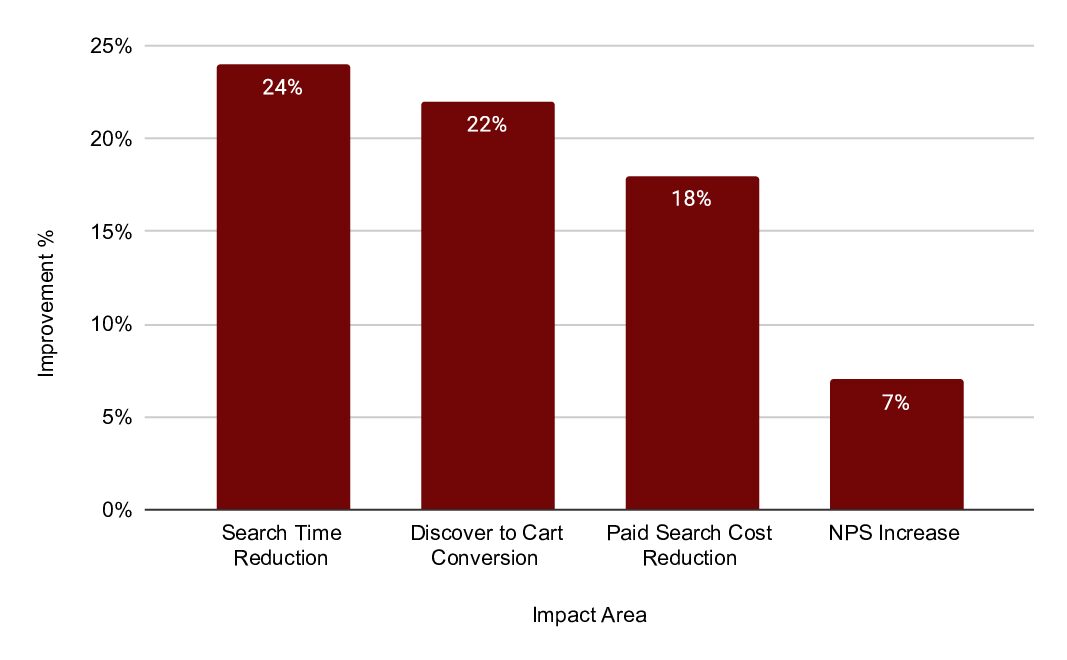
- Search time reduction (24%)
- Conversion improvements (22% growth in “discover to cart”)
- Cost savings (18% reduction in paid search spending)
- User satisfaction (NPS increase of 7 points)
- Reduce of click through rate
Key Learnings
01. "User-centricity is paramount"
Every decision must prioritize the end user’s needs and experience.
02. "Early and continuous testing is critical"
Iterative feedback loops prevent costly mistakes and accelerate success.
03. "Cross-functional collaboration accelerates success"
Breaking down silos enables faster innovation and better outcomes.
04. "Balance technical and business metrics"
Success requires measuring both system performance and business impact.
05. Artificial Intelligence Needs KPI to Follow
Defining clear KPIs for AI initiatives ensures alignment with business goals and facilitates ongoing evaluation of effectiveness and ROI. Without measurable objectives, AI projects risk losing direction and failing to deliver meaningful results.
Future Directions
Multi-Item Recognition Capability
Identify multiple products in a single image
Video Search Functionality
Search using video clips instead of static images
Augmented Reality Integration
Visualize products in real-world environments
Cross-Platform Expansion
Extend visual search to web and additional devices
Contact SkuzaAI
© Arek Skuza 2023. All rights reserved.