

What’s at Stake
In today’s manufacturing environment, quality control represents both a significant cost center and a critical competitive differentiator. For C-suite leaders, particularly those in manufacturing, electronics, and automotive sectors, the decision to implement automated visual inspection systems carries substantial financial implications. While the market for these technologies continues its rapid expansion—projected to grow from $16.69 billion in 2024 to $19.04 billion in 2025—many executives struggle to accurately quantify the return on their automation investments.
The challenge extends beyond simple cost calculations. Traditional ROI models often fail to capture the full spectrum of benefits that automated inspection delivers, from labor savings to quality improvements and enhanced operational efficiency. This analytical gap leads to delayed implementation, suboptimal deployment strategies, and ultimately, missed opportunities for value creation. For manufacturing executives, the ability to precisely calculate and maximize ROI from visual inspection technologies has become a strategic imperative, not merely a financial exercise.
What the Numbers Say
$691,200 – Average annual labor savings per production line reported by manufacturing and electronics companies implementing automated visual inspection systems
75% – Typical first-year ROI achieved by companies that properly implement and optimize automated inspection technologies
$1.35 million – Annual net benefit realized by an automotive supplier after replacing manual inspections with AI-powered visual inspection for aluminum parts
Reframing ROI: Beyond Simple Cost Reduction
The conventional approach to calculating ROI for automated visual inspection systems often focuses narrowly on labor cost reduction. While this represents a significant benefit, forward-thinking executives recognize that the true value proposition extends far beyond headcount savings. The most sophisticated manufacturers are adopting a comprehensive framework that captures both quantifiable financial returns and strategic competitive advantages.
Quantify All Cost Components, Not Just the Obvious Ones
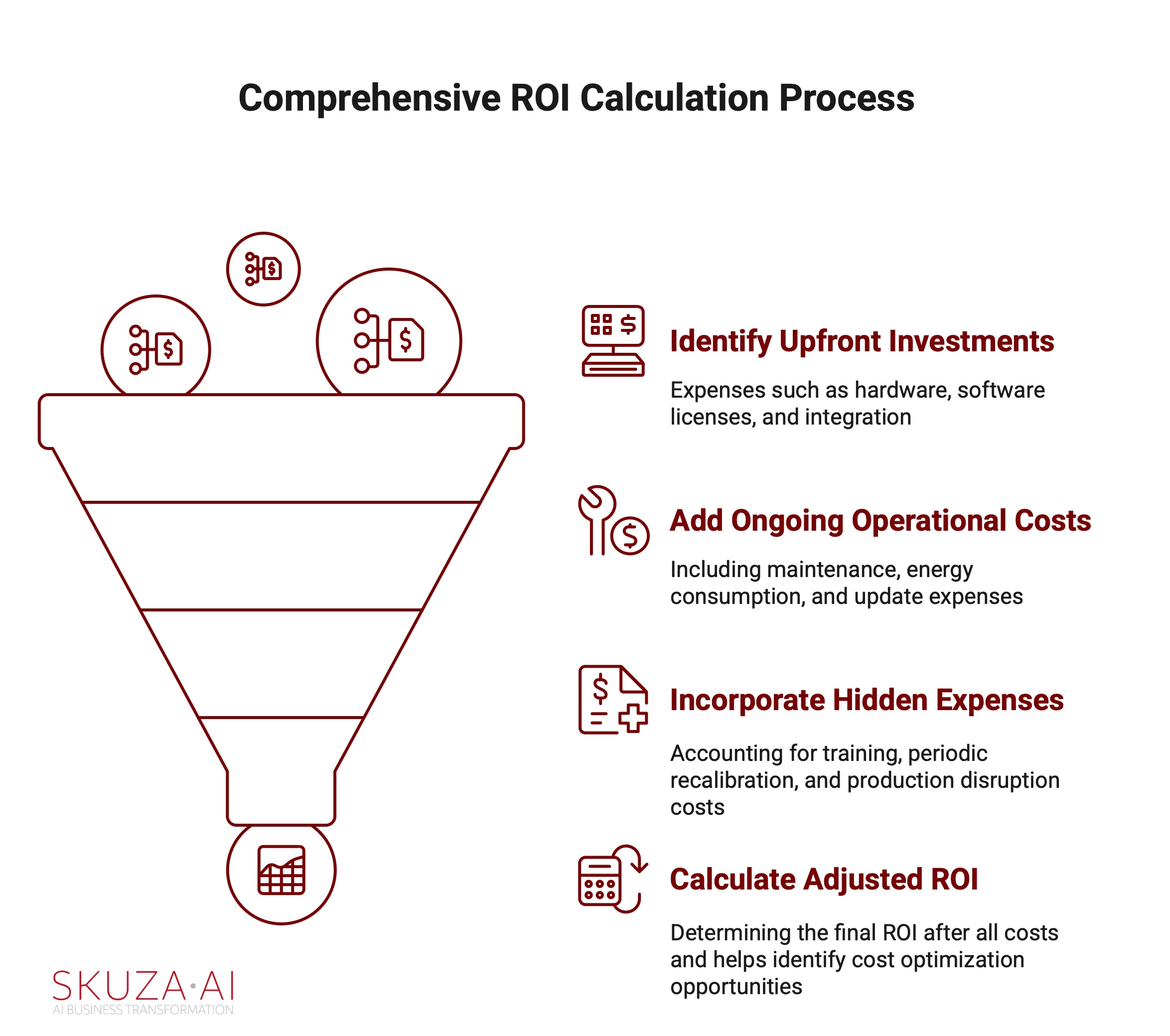
Most ROI calculations begin with identifying upfront costs—hardware, software licenses, and integration expenses. However, this approach frequently overlooks critical cost elements that can significantly impact the total investment. Leading manufacturers conduct thorough cost analyses that include ongoing operational expenses, calibration requirements, and potential production disruptions during implementation.
For example, a global electronics manufacturer initially calculated a 40% ROI based on hardware and integration costs alone. After incorporating maintenance, software updates, and periodic recalibration expenses, their projected ROI decreased to 28%. While still compelling, this more accurate figure allowed for better resource allocation and implementation planning.
Potential First Step: Create a comprehensive cost inventory that extends beyond capital expenditures. Include three categories: upfront investments (hardware, software, integration), ongoing operational costs (maintenance, updates, energy consumption), and hidden expenses (training, periodic recalibration, potential production disruptions). This detailed accounting provides the foundation for accurate ROI calculations and helps identify opportunities for cost optimization.
Measure Quality Improvements in Financial Terms
Quality enhancements represent one of the most significant—yet frequently undervalued—benefits of automated inspection. The challenge lies in translating quality metrics into financial terms that resonate with C-suite decision-makers. Leading companies have developed sophisticated methodologies to quantify these benefits.
A precision components manufacturer implemented an automated visual inspection system that reduced defect escapes by 87%. Rather than simply reporting this quality improvement, they calculated its financial impact: $1.2 million in annual savings from reduced warranty claims, $450,000 from decreased rework costs, and $300,000 from lower scrap rates. This comprehensive financial analysis revealed that quality improvements delivered 65% of the total ROI—far exceeding the value of labor savings.
Potential First Step: Establish clear financial linkages between quality metrics and bottom-line results. Calculate the full cost of quality issues, including scrap, rework, warranty claims, returns, and brand reputation impacts. Then project the financial benefit of reducing these costs through automated inspection. This approach transforms quality from a technical consideration to a strategic financial driver.
Capture Operational Efficiency Gains
Automated visual inspection systems deliver significant operational benefits beyond direct labor and quality improvements. These include increased throughput, reduced bottlenecks, and enhanced Overall Equipment Effectiveness (OEE). Leading manufacturers have developed methodologies to quantify these operational gains in financial terms.
A major automotive supplier calculated that their automated inspection system saved 5,000 production minutes annually by eliminating bottlenecks in their quality control process. With production valued at $5 per minute, this operational improvement contributed $25,000 annually to their ROI calculation. More importantly, it enabled them to increase production capacity without capital investment in additional equipment.
Potential First Step: Identify and measure production constraints that automated inspection can address. Calculate the value of increased throughput, reduced bottlenecks, and improved OEE in financial terms. This analysis often reveals that operational efficiency gains contribute significantly to total ROI, particularly in high-volume, capacity-constrained manufacturing environments.
Implementing a Strategic ROI Framework
While the benefits of automated visual inspection are compelling, realizing maximum ROI requires a strategic approach to implementation and optimization. Leading manufacturers have developed sophisticated frameworks that ensure their investments deliver maximum value.
Align Deployment with Strategic Priorities
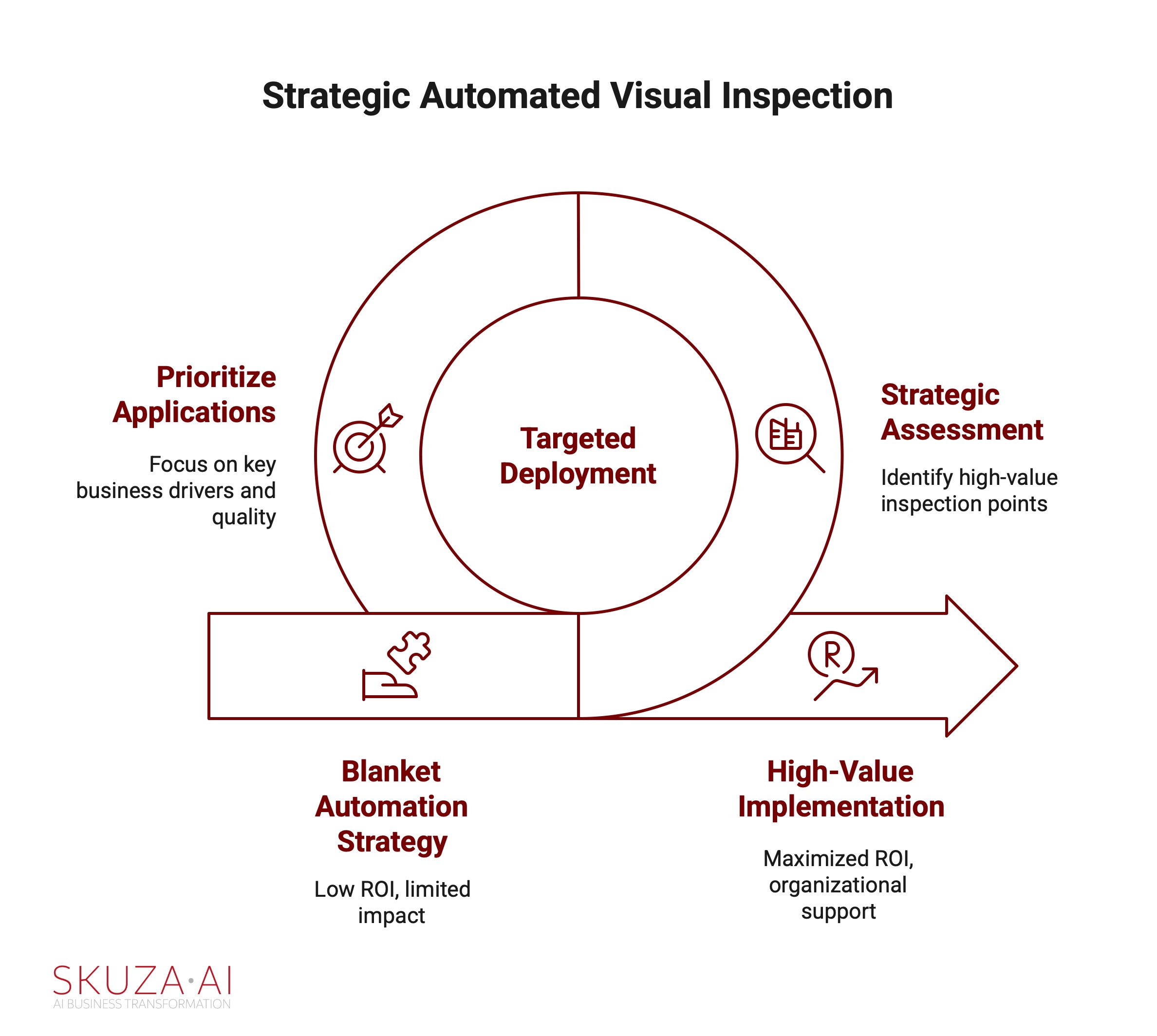
The most successful implementations of automated visual inspection align technology deployment with strategic business priorities. Rather than pursuing a blanket automation strategy, leading manufacturers target specific applications where inspection technology can deliver maximum value.
A global consumer electronics manufacturer prioritized automated inspection for high-margin product lines where quality directly impacted brand perception and pricing power. This targeted approach delivered a 92% ROI in the first year, compared to 45% for their previous facility-wide implementation. By focusing on strategic priorities, they maximized financial returns while building organizational support for broader deployment.
Potential First Step: Conduct a strategic assessment of your manufacturing operations to identify inspection points with the highest potential value. Prioritize applications where quality directly impacts pricing power, customer retention, or regulatory compliance. This targeted approach delivers higher ROI and builds momentum for broader implementation.
Implement Phased Deployment with Continuous Optimization
Rather than pursuing a “big bang” implementation, leading manufacturers adopt a phased approach that allows for continuous learning and optimization. This strategy not only reduces implementation risk but also enables higher ROI through iterative improvement.
A precision medical device manufacturer implemented automated inspection in three phases: critical safety features first, cosmetic inspections second, and packaging verification third. This approach allowed them to refine their implementation methodology, optimize detection algorithms, and build internal expertise. By the third phase, their implementation efficiency had improved by 65%, significantly enhancing overall ROI.
Potential First Step: Develop a phased implementation roadmap that prioritizes high-value applications while building organizational capabilities. Establish clear metrics for each phase and incorporate learnings into subsequent deployments. This approach reduces implementation risk while maximizing long-term ROI.
Leverage Data for Continuous Improvement
The most sophisticated manufacturers recognize that automated inspection systems generate valuable data beyond simple pass/fail decisions. This data can drive continuous improvement in manufacturing processes, further enhancing ROI.
A leading automotive supplier implemented an automated inspection system that identified subtle patterns in defect occurrence. Analysis of this data revealed that specific process parameters were contributing to quality issues. By adjusting these parameters, they reduced defect rates by 32%, delivering an additional $450,000 in annual savings beyond the direct benefits of automated inspection.
Potential First Step: Implement data analytics capabilities that transform inspection results into actionable insights. Establish cross-functional teams to analyze this data and identify process improvement opportunities. This approach transforms automated inspection from a quality control tool to a strategic driver of manufacturing excellence.
What is in there
The true value of automated visual inspection extends far beyond labor savings or defect detection. For forward-thinking executives, these technologies represent a strategic opportunity to simultaneously reduce costs, enhance quality, and generate data-driven insights that drive continuous improvement. The companies that realize the highest ROI from automated inspection are those that view it not merely as a quality control tool, but as a strategic asset that transforms manufacturing operations.
As the market for automated visual inspection continues its rapid growth, the competitive advantage will increasingly shift from simply having the technology to implementing it strategically and maximizing its value contribution. The executives who master this capability—who can accurately calculate, communicate, and continuously improve ROI—will position their organizations for sustained competitive advantage in an increasingly quality-conscious and cost-competitive global marketplace.