Optimizing Motor Rehabilitation: Machine Learning Solutions for Parkinson’s and Stroke Recovery
This case study explores the problems SkuzaAI solved for a healthcare company that uses machine learning algorithms to improve the motor function of patients with Parkinson’s disease and patients in recovery after experiencing a stroke.
Introduction
The healthcare company, a leader in the rehabilitation industry, sought to enhance its service offerings with personalized therapeutic pathways. Faced with the challenge of variability in patient needs and the complexity of gait and balance metrics, they turned to us for our expertise in machine learning algorithms. The broader industry landscape underscores the importance of such personalized pathways, given the diverse progression and recovery patterns in Parkinson’s and stroke patients.
1M
People in the U.S.
Nearly one million people in the U.S. are living with Parkinson’s disease
60K
New Cases Annually
60,000 new Parkinson’s cases diagnosed each year
795K
Stroke Patients
More than 795,000 people experience a new or recurrent stroke annually
40s
Stroke Frequency
Every 40 seconds, someone in the United States has a stroke
Problems Addressed
Personalized Therapeutic Pathways
Developing personalized therapeutic pathways for patients with Parkinson’s and post-stroke recovery. Choose appropriate AI algorithms for the challenge.
Critical Indicators
Selecting and monitoring critical indicators to track patient progress effectively. Defining and setting up the data points which will be relevant and comprehensive for 360 analysis.
Seamless Integration
Ensuring seamless integration of machine learning models with existing medical-grade devices (SoundsStep) considering cybersecurity challenges.
Team Competencies
Enhancing the team’s competencies to support ongoing innovation and compliance with regulatory standards.
Recommendation of Therapeutic Pathways for Patients with Parkinson’s and After Strokes
First, Arek designed and team created detailed criteria for a machine learning model that can recommend therapeutic pathways for patients with Parkinson’s and after strokes.
These criteria involved gait and balance metrics, correlation analysis between these metrics, selecting a suitable algorithm, designing the model training process, and creating an API for information exchange between the model and medical devices.
Define Criteria
Collect Gait Metrics
Correlation Analysis
Select Algorithm
Train & API
Rationale Behind the Solution
Selection of Machine Learning Algorithms
SkuzaAI conducted a thorough analysis of various algorithms, selecting those best suited for processing gait and balance metrics. The decision-making process involved comparative experiments to identify the most effective algorithm for therapeutic recommendations.
Key Steps in the Process
Iterative Development Process
The model development was iterative, starting with detailed criteria for gait and balance metrics (e.g., number of steps, heel strike, step length, cadence). Each iteration involved data collection, preprocessing, feature extraction, and evaluation to refine the model continuously.
Definition of Gait and Balance Metrics
Metrics such as number of steps, heel strike, step length, cadence, stride time, symmetry, variability, and gait speed were selected for model evaluation and API integration.
Correlation of Metrics with Sound
A correlation analysis between gait/balance metrics and sound was conducted to identify musical features enhancing motor function. This involved selecting analysis methods, correlating tests, and choosing musical features.
Designing Requirements for ML Model
The focus was on selecting a suitable machine learning algorithm, conducting comparative experiments, and designing a dedicated algorithm for treatment recommendation based on specific metrics.
Model Training Process
Once the algorithm was selected, the model was trained on a representative dataset. This involved data preparation, model training based on stages like data collection, preprocessing, feature extraction, and evaluation.
API Design
Designing an API to exchange information between the model and medical devices. This involved defining requirements, architecture, development, testing, and ensuring security, privacy, compliance, and usability.
Results and Impact
Designed System Architecture
The system architecture integrated real-time data processing with adaptive machine learning models, enabling personalized treatment plans. This holistic approach enhanced motor function outcomes and streamlined clinical workflows.
Defined Datapoints Required for AI
These variables were critical in tailoring recommendations and improving predictive accuracy.
Selecting AI Models
Careful evaluation of several AI models was conducted, prioritizing those with strong performance in pattern recognition and adaptability to diverse patient data. This selection ensured robustness and reliability in clinical applications.
ROI and Costs Preparation
Comprehensive ROI analysis highlighted cost savings through reduced hospital readmissions and optimized therapy sessions. Budget planning accounted for development expenses while projecting long-term financial benefits and scalability.
Personalized Therapies Design
Personalized therapies templates were crafted using insights from patient-specific data, allowing customization that addresses individual needs and accelerates recovery.
Selection of Indicators to Monitor
Key Indicators and Monitoring Process
We also developed key indicators the healthcare company should monitor, involving the training of a machine learning model, integration of SoundSteps™ with medical-grade devices, data collection from users and devices, and iterative model refinement. These indicators include:
01. Data Collection and Model Training
Gathering data from users using the SoundSteps prototype in lab settings to train the ML model. Physiotherapists and experts adjust the sound to match the user’s gait.
02. Integration and Iteration with Medical Devices
Developing algorithms to connect devices to SoundSteps, testing with healthy subjects, analyzing data for modifications, and iteratively training the ML model using gait sampling videos and paired partner devices.
03. Data Collection from Partners
Partner universities collect data from SoundSteps users, analyze it for potential issues, and provide feedback.
04. Personalized Playback Configurations
The ML model sends personalized music recommendations to SoundSteps devices. Recommendations are critiqued by partner institutions.
05. Expert Tuning of ML Model
Experts in physical and music therapy review video footage and ML model recommendations.
06. Infinite Model Training Process
Continuous refinement of the ML model using user feedback.
07. Quality Metrics and User Satisfaction
Setting quality metrics for the ML model’s recommendations and aiming for high user satisfaction and improved gait.
Description of the Competencies of the Team Necessary to Carry Out the Task
Arek also helped the healthcare company develop a list of competencies to develop a team ideal for crafting the machine learning model.
These competencies include:
Machine Learning and Data Science
Experts in machine learning and data science are crucial for developing, training, and refining the ML model.
Physiotherapy and Rehabilitation
Physiotherapists play a vital role in understanding gait patterns, assessing user needs, and providing input for sound adjustments to match gait.
Medical and Therapeutic Expertise
Medical professionals specializing in areas such as orthopedics, neurology, and rehabilitation medicine provide valuable insights into the correlation between gait metrics and therapeutic outcomes.
Sound Engineering and Music Therapy
Professionals with knowledge in sound engineering and music therapy contribute to designing soundtracks that enhance motor function.
Software Development and Integration
Skilled software developers are required to integrate SoundSteps with medical-grade devices, design the API, and ensure seamless communication between hardware and software components.
User Experience (UX) Design
UX designers focus on creating intuitive interfaces for SoundSteps devices and associated applications.
Regulatory Compliance and Legal Expertise
Professionals with knowledge of healthcare regulations, such as HIPAA and GDPR, ensure that SoundSteps complies with data privacy and security standards.
Conclusion
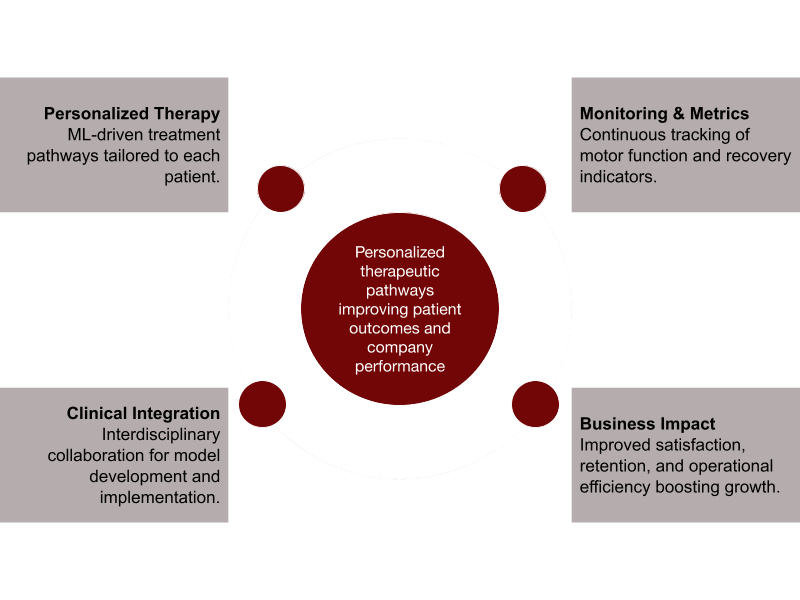
In conclusion, the project with the healthcare company focused on utilizing machine learning to enhance motor function in Parkinson’s and stroke patients. By recommending personalized treatment pathways and monitoring indicators, we emphasized interdisciplinary expertise for effective model development and implementation.
This approach not only improved patient care and rehabilitation outcomes but also seamlessly integrated into the company’s operations. The enhanced service offerings led to higher customer satisfaction, increased patient retention, and positive word-of-mouth, which collectively drove business growth and boosted sales.
By streamlining customer operations, the company was able to provide more efficient and effective care, enhancing overall operational efficiency. This successful integration of advanced technology underscores the significant impact personalized therapeutic pathways can have on both patient outcomes and the healthcare company’s market position.