
Customer Story:
AI Integration in Legal Services Vertical: Navigating Challenges for Effective Litigation Support
Arek partnered with a Currenda, a legal professional organization, to develop an innovative AI-powered service specifically designed for its attorney and lawyer members.
Recognizing the unique challenges facing legal professionals in adopting AI technologies, he created a tailored solution that addresses their specific workflow needs while maintaining the rigorous compliance and confidentiality standards required in the legal industry.
The Challenge: AI Adoption for Legal Services
A prominent legal professional organization, Currenda, approached SkuzaAI seeking expertise to determine the most effective artificial intelligence (AI) and machine learning techniques to enhance the services offered to their attorney and lawyer members.
Arek’s a highly skilled professional with exceptional communication abilities and a keen interest in AI technology advancements. He contributes effectively to the development of innovative solutions by staying ahead of market trends and demonstrating meticulous attention to detail.
Arek’s passion, dedication and professionalism make him valuable asset to any organisation. Arek helped us to craft an AI strategy for our customer-facing product. Part of his responsibility was to prepare, design, and calculate the cost of AI architecture. His expertise helped us decide which AI development roadmap we needed to follow to achieve the best combination of AI-powered features.
Defining AI Scope
Clearly defining the role and boundaries of AI in legal service enhancement.
Service Interoperability
Integrating AI solutions with existing legal platforms and member workflows.
Member Readiness
Ensuring legal professionals are equipped and trained to utilize AI effectively.
Ethical & Compliance Risks
Addressing data privacy, ethical AI use, and regulatory compliance in legal applications.
Platform Integration
Compatibility of new AI tools with the organization’s current technological infrastructure.
My primary challenges in charting the optimal course involved defining the scope for AI implementation in legal services, ensuring interoperability with existing tools, preparing member professionals, managing AI-related ethical and compliance risks, and integrating with current infrastructure.
Selecting Processes for AI Support
The challenges for selecting processes for AI support include:
01. Data Quality Issues
Incomplete, inaccurate, or biased datasets can impede the training and performance of AI models, affecting their ability to automate processes effectively.
02. Lack of Clear Criteria
Without well-defined criteria for selecting processes, there is ambiguity in determining which tasks are most suitable for automation, leading to challenges in decision-making.
03. Complexity of Processes
Some processes may be inherently complex or dynamic, making it challenging to develop AI models that can adapt and automate these tasks accurately.
04. Integration with Existing Systems
Compatibility issues and integration challenges with existing systems can hinder the seamless implementation of AI automation into established workflows.
SkuzaAI Approach
The approach to analyzing the company’s systems and documents to pinpoint opportunities for AI intervention involved multiple steps:

1
Understand Business Processes
The first step is to gain a thorough understanding of existing business processes and workflows. Identify tasks that are repetitive, rule-based, time-consuming, or prone to human error.
2
Audit Processes and Analyze Data
Conduct a detailed audit of existing processes and document the key steps involved. Then, analyze the data involved with these processes to determine whether the data within the process is suitable for training AI models.
3
Evaluate System Integration
Assess the integration capabilities of the systems to identify whether the AI solutions need to interface with other software or databases and evaluate the feasibility of seamless integration.
4
Identify and Prioritize Opportunities
Identify the opportunities for AI intervention and prioritize them based on potential impact, feasibility, and alignment with organizational goals.
Optimizing AI Maintenance Costs
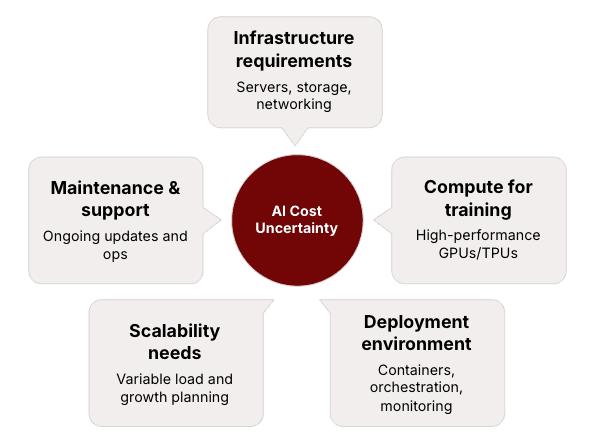
Cost Optimization Methodology
The methodology used for estimating and optimizing AI maintenance costs is comprehensive and involves a thoughtful approach tailored to the specific systems and usage of the customer.
First, conduct in-depth interviews with the customer to gain insights into their AI system’s requirements. These interviews focus on understanding the volume of computer power, storage capacity, and data transfer needs for ensuring a scalable solution.
Customer Interviews
Understanding system requirements and needs
Technology Team Dialogue
Discussing infrastructure strategy
Strategic Alignment
Ensuring cost-effectiveness
Furthermore, engage with the technology team to discuss critical factors, including server locations and the strategic decision between cloud-based and on-premise solutions. This dialogue with the technology team is pivotal for aligning the AI infrastructure with the organization’s broader technology strategy and ensuring optimal performance, security, and cost-effectiveness.
Integration Architecture Design
Integrating different software components in a customer’s platform is complex due to varied architectures, data formats, and communication protocols. Compatibility challenges, version management, and coordination among legacy systems, third-party APIs, and new components add intricacy.
Our Solution
Designing and co-creating an efficient and scalable integration architecture by leveraging expertise in both technology and business processes addressed these complexities. Arek begins with a comprehensive analysis of the customer’s existing systems and software components. Then, he facilitates collaborative sessions with key stakeholders to understand the intricacies of the workflow, identify critical integration points, and assess the specific requirements for efficiency and scalability.
Also, collaborate closely with the technology team to discuss server locations, cloud versus on-premise strategies, and optimal ways to handle data transfer and storage. Fostering open communication and collaboration facilitates the alignment of technical decisions with broader business objectives.
Assess
Analyze existing systems and components
Engage
Run stakeholder workshops to map workflows
Design
Define integration points and requirements
Architect
Plan cloud, on-prem, and data strategies
Align
Ensure technical choices meet business goals
Initial Scope Considerations Versus the Finalized Scope After Involvement
Project Team Restructuring
Initial Limitations
Before restructuring, the project team faced several challenges:
- Scattered roles & lack of AI expertise
- Deficiency in data science skills
- Poor interdisciplinary collaboration
- Insufficient IT support
Systematic Restructuring Process
The transformation initiated with a thorough skills assessment, identifying gaps, and then addressing these through recruitment or training to build a more effective AI project execution team.
Optimized Structure by SkuzaAI
The restructured team now boasts a robust foundation for AI projects:
- Organized roles with clear AI expertise
- Enhanced data science capabilities
- Strong cross-functional collaboration
- Integrated and robust IT support
Before and After SkuzaAI Intervention
Conclusion
In addressing the integration of AI in legal software development, challenges were navigated through strategic interventions. The approach involved meticulous analysis, comprehensive methodologies, and targeted solutions.
From selecting processes for AI support to addressing maintenance cost concerns and team restructuring, our strategies ensured clarity, collaboration, and efficiency. The company is now poised as an innovator in legal technology, ready to implement their desired AI solution.